← 2024 Paper 1

UPSC 2024 Maths Optional Paper 1 Q1c — Step-by-Step Solution

10 marks · Section A

Continuity of real functions · Calculus · asked 2× in 13 yrs · Read the full method →

Question

Discuss the continuity of the function

f(x)={11e1/x,x00,x=0f(x)=\begin{cases}\dfrac{1}{1-e^{-1/x}}, & x\ne 0\\ 0, & x=0\end{cases}

for all values of xx.

Technique

One-sided limits at x=0x=0 by examining the sign of 1/x-1/x as x0±x\to 0^\pm.

Solution

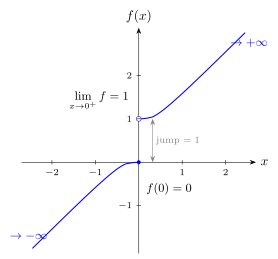
Graph of f(x)=1/(1-e^{-1/x}) near x=0. The left branch (x<0) rises from 0 toward the origin, where f(0)=0 is marked by a filled dot; the right branch (x>0) descends toward height 1, marked by an open circle at (0,1) since the value 1 is approached but not attained from the right. The two one-sided limits differ (0 on the left, 1 on the right), exhibiting a jump discontinuity at x=0.

Step 1 — Continuity for x0x\ne 0.

For x0x\ne 0, the exponent 1/x-1/x is finite and non-zero, so e1/x1e^{-1/x}\ne 1, making the denominator 1e1/x01-e^{-1/x}\ne 0. The function is a composition of elementary continuous functions, hence continuous at every x0x\ne 0.

Step 2 — One-sided limits at x=0x=0.

As x0+x\to 0^+: 1/x-1/x\to-\infty, so e1/x0e^{-1/x}\to 0, giving f(x)110=1f(x)\to \dfrac{1}{1-0}=1.

As x0x\to 0^-: 1/x+-1/x\to+\infty, so e1/x+e^{-1/x}\to+\infty, giving f(x)11=0f(x)\to \dfrac{1}{1-\infty}=0.

Step 3 — Compare with f(0)=0f(0)=0.

The two one-sided limits exist but are unequal, so the two-sided limit does not exist.
Answer

  f is continuous for all x0;  f has a jump discontinuity at x=0 (left-continuous but not right-continuous).  \boxed{\;f\text{ is continuous for all }x\ne 0;\;f\text{ has a jump discontinuity at }x=0\text{ (left-continuous but not right-continuous).}\;}
We post more of this — worked solutions, CSAT trap breakdowns, guide chapters — a few times a week on Telegram. Free, no sign-in. Join

This solution is part of the Maths Coverage Map — 13 years, mapped. Get the take-away PDF free.