UPSC 2024 Maths Optional Paper 1 Q7a — Step-by-Step Solution
15 marks · Section B
Picard's Existence/Uniqueness Theorem; Lipschitz Condition · ODEs · Read the full method →
Question
State the uniqueness theorem for the existence of a unique solution of the IVP dxdy=f(x,y), y(x0)=y0 in the rectangle R:∣x−x0∣≤a,∣y−y0∣≤b. Test the existence and uniqueness of the solution of dxdy=2y,y(1)=0. If more than one solution exists, find all of them.
Technique
State Picard–Lindelöf; check Lipschitz via ∂f/∂y; construct the non-unique solution family by patching.
Solution
Picard–Lindelöf Theorem
Let f(x,y) be continuous on R:∣x−x0∣≤a,∣y−y0∣≤b, and satisfy a Lipschitz condition in y on R:
∣f(x,y1)−f(x,y2)∣≤L∣y1−y2∣
for some L>0. Let M=maxR∣f∣ and h=min(a,b/M). Then the IVP has a unique solution on ∣x−x0∣≤h.
Application to f(x,y)=2y, y(1)=0
Continuity:2y is continuous on y≥0. Existence is guaranteed by Peano’s theorem.
Lipschitz check:∂f/∂y=1/y→∞ as y→0+. More directly, for y1,y2≥0:
∣2y1−2y2∣=y1+y22∣y1−y2∣→∞ as y1,y2→0.
No Lipschitz constant exists on any rectangle containing (1,0). Picard’s theorem does not guarantee uniqueness.
All Solutions
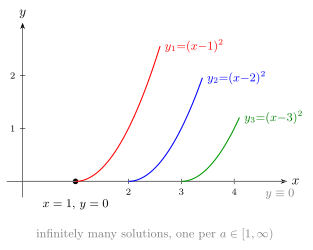
Separating variables for y>0: dy/(2y)=dx⇒y=x+C. With y(1)=0: C=−1, so one solution is y=(x−1)2 for x≥1.
But y≡0 also satisfies the ODE and y(1)=0.
General family. For each a≥1, define
ya(x)={0,(x−a)2,x≤a,x>a.
At the join x=a: ya is continuous (both give 0) and ya′ is continuous (both give 0). Each piece satisfies the ODE. And ya(1)=0 since a≥1.
Answer
ya(x)={0,(x−a)2,x≤ax>afor any a∈[1,∞).
There are infinitely many solutions. The case a=1 gives y=(x−1)2 for x>1; a→∞ gives y≡0.