← 2023 Paper 1
UPSC 2023 Maths Optional Paper 1 Q6b — Step-by-Step Solution 15 marks · Section B
Projectile motion · Dynamics & Statics · asked 5× in 13 yrs · Read the full method →
Question
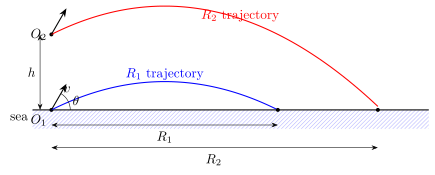
When a particle is projected from a point O 1 O_1 O 1 v v v θ \theta θ R 1 R_1 R 1 O 2 O_2 O 2 O 1 O_1 O 1 h h h v v v θ \theta θ R 2 R_2 R 2 R 2 > R 1 R_2>R_1 R 2 > R 1 ( R 2 − R 1 ) : R 1 (R_2-R_1):R_1 ( R 2 − R 1 ) : R 1
1 2 { 1 + 2 g h v 2 sin 2 θ − 1 } : 1. \tfrac{1}{2}\Bigl\{\sqrt{1+\tfrac{2gh}{v^2\sin^2\theta}}-1\Bigr\}:1. 2 1 { 1 + v 2 s i n 2 θ 2 g h − 1 } : 1. Technique
Standard projectile kinematics; compute time-of-flight in each case; express the ratio explicitly. The factoring v sin θ v\sin\theta v sin θ
Solution
Setup. Initial velocity components: u x = v cos θ , u y = v sin θ u_x=v\cos\theta,\,u_y=v\sin\theta u x = v cos θ , u y = v sin θ
From sea level (O 1 O_1 O 1
Vertical motion: y ( t ) = v sin θ ⋅ t − 1 2 g t 2 = 0 y(t)=v\sin\theta\cdot t-\tfrac{1}{2}gt^2=0 y ( t ) = v sin θ ⋅ t − 2 1 g t 2 = 0 t 1 = 2 v sin θ / g t_1=2v\sin\theta/g t 1 = 2 v sin θ / g R 1 = v cos θ ⋅ t 1 = 2 v 2 sin θ cos θ g = v 2 sin 2 θ g . R_1=v\cos\theta\cdot t_1=\dfrac{2v^2\sin\theta\cos\theta}{g}=\dfrac{v^2\sin 2\theta}{g}. R 1 = v cos θ ⋅ t 1 = g 2 v 2 sin θ cos θ = g v 2 sin 2 θ .
From height h h h O 2 O_2 O 2
Vertical motion: y ( t ) = h + v sin θ ⋅ t − 1 2 g t 2 = 0 y(t)=h+v\sin\theta\cdot t-\tfrac{1}{2}gt^2=0 y ( t ) = h + v sin θ ⋅ t − 2 1 g t 2 = 0 t t t
1 2 g t 2 − v sin θ ⋅ t − h = 0 ⇒ t = v sin θ + v 2 sin 2 θ + 2 g h g . \tfrac{1}{2}gt^2-v\sin\theta\cdot t-h=0\Rightarrow t=\frac{v\sin\theta+\sqrt{v^2\sin^2\theta+2gh}}{g}. 2 1 g t 2 − v sin θ ⋅ t − h = 0 ⇒ t = g v sin θ + v 2 sin 2 θ + 2 g h . (Taking the positive root since t > 0 t>0 t > 0
Horizontal range:
R 2 = v cos θ ⋅ t = v cos θ g [ v sin θ + v 2 sin 2 θ + 2 g h ] . R_2=v\cos\theta\cdot t=\frac{v\cos\theta}{g}\bigl[v\sin\theta+\sqrt{v^2\sin^2\theta+2gh}\bigr]. R 2 = v cos θ ⋅ t = g v cos θ [ v sin θ + v 2 sin 2 θ + 2 g h ] . Step 1 — Show R 2 > R 1 R_2>R_1 R 2 > R 1
R 2 − R 1 = v cos θ g [ v sin θ + v 2 sin 2 θ + 2 g h − 2 v sin θ ] = v cos θ g [ v 2 sin 2 θ + 2 g h − v sin θ ] . R_2-R_1=\dfrac{v\cos\theta}{g}\bigl[v\sin\theta+\sqrt{v^2\sin^2\theta+2gh}-2v\sin\theta\bigr]=\dfrac{v\cos\theta}{g}\bigl[\sqrt{v^2\sin^2\theta+2gh}-v\sin\theta\bigr]. R 2 − R 1 = g v cos θ [ v sin θ + v 2 sin 2 θ + 2 g h − 2 v sin θ ] = g v cos θ [ v 2 sin 2 θ + 2 g h − v sin θ ] .
Since h > 0 h>0 h > 0 v 2 sin 2 θ + 2 g h > v sin θ \sqrt{v^2\sin^2\theta+2gh}>v\sin\theta v 2 sin 2 θ + 2 g h > v sin θ R 2 − R 1 > 0 R_2-R_1>0 R 2 − R 1 > 0 R 2 > R 1 R_2>R_1 R 2 > R 1
Step 2 — Compute the ratio
R 2 − R 1 R 1 = ( v cos θ / g ) [ v 2 sin 2 θ + 2 g h − v sin θ ] ( v cos θ / g ) ⋅ 2 v sin θ = v 2 sin 2 θ + 2 g h − v sin θ 2 v sin θ . \frac{R_2-R_1}{R_1}=\frac{(v\cos\theta/g)\bigl[\sqrt{v^2\sin^2\theta+2gh}-v\sin\theta\bigr]}{(v\cos\theta/g)\cdot 2v\sin\theta}=\frac{\sqrt{v^2\sin^2\theta+2gh}-v\sin\theta}{2v\sin\theta}. R 1 R 2 − R 1 = ( v cos θ / g ) ⋅ 2 v sin θ ( v cos θ / g ) [ v 2 sin 2 θ + 2 g h − v sin θ ] = 2 v sin θ v 2 sin 2 θ + 2 g h − v sin θ . Factor v sin θ v\sin\theta v sin θ
v 2 sin 2 θ + 2 g h = v sin θ 1 + 2 g h v 2 sin 2 θ . \sqrt{v^2\sin^2\theta+2gh}=v\sin\theta\sqrt{1+\frac{2gh}{v^2\sin^2\theta}}. v 2 sin 2 θ + 2 g h = v sin θ 1 + v 2 sin 2 θ 2 g h . Substitute:
R 2 − R 1 R 1 = v sin θ 1 + 2 g h v 2 sin 2 θ − v sin θ 2 v sin θ = 1 + 2 g h v 2 sin 2 θ − 1 2 . \frac{R_2-R_1}{R_1}=\frac{v\sin\theta\sqrt{1+\frac{2gh}{v^2\sin^2\theta}}-v\sin\theta}{2v\sin\theta}=\frac{\sqrt{1+\frac{2gh}{v^2\sin^2\theta}}-1}{2}. R 1 R 2 − R 1 = 2 v sin θ v sin θ 1 + v 2 s i n 2 θ 2 g h − v sin θ = 2 1 + v 2 s i n 2 θ 2 g h − 1 . Answer
( R 2 − R 1 ) : R 1 = 1 2 [ 1 + 2 g h v 2 sin 2 θ − 1 ] : 1. \boxed{\;(R_2-R_1):R_1=\tfrac{1}{2}\bigl[\sqrt{1+\tfrac{2gh}{v^2\sin^2\theta}}-1\bigr]:1.\;} ( R 2 − R 1 ) : R 1 = 2 1 [ 1 + v 2 s i n 2 θ 2 g h − 1 ] : 1.