← 2023 Paper 1

UPSC 2023 Maths Optional Paper 1 Q6c — Step-by-Step Solution

20 marks · Section B

Gauss divergence theorem · Vector Analysis · asked 9× in 13 yrs · Read the full method →

Question

Evaluate the integral

S(3y2z2i^+4z2x2j^+z2y2k^)n^dS,\iint_S(3y^2 z^2\hat i+4z^2 x^2\hat j+z^2 y^2\hat k)\cdot\hat n\,dS,

where SS is the upper part of the surface 4x2+4y2+4z2=14x^2+4y^2+4z^2=1 above the plane z=0z=0 and bounded by the xyxy-plane. Hence, verify Gauss-Divergence theorem.

Technique

Use divergence theorem to convert the surface integral on SS (a hemisphere) to a volume integral on the half-ball, plus a flat-disk contribution that vanishes (since the integrand has z2z^2 factor on k^\hat k-component).

Solution

Note on SS. The equation 4x2+4y2+4z2=14x^2+4y^2+4z^2=1 is the sphere x2+y2+z2=1/4x^2+y^2+z^2=1/4, i.e., radius 1/21/2. SS is the upper hemisphere (z0z\ge 0).

Strategy. Compute the volume integral via the divergence theorem (much easier), then deduce the surface integral over SS alone.

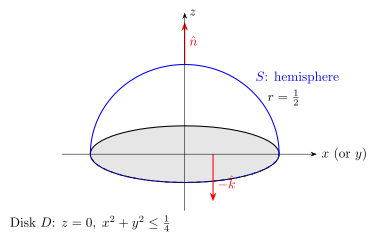
The upper hemisphere S (radius r=\tfrac12, blue, carrying outward normal \hat n) is not closed; closing it with the flat disk D at z=0 (carrying outward normal -\hat k) bounds the solid half-ball V. The divergence theorem applies to the closed boundary S\cup D; since the flux through D vanishes (the \hat k-component of \vec F has a factor z^2=0 on D), the flux through S equals the volume integral.

Step 1 — Apply the divergence theorem to the closed half-ball

Let VV be the upper half-ball (x2+y2+z21/4,z0x^2+y^2+z^2\le 1/4,\,z\ge 0). Its boundary is SS (hemispherical part) ∪ DD (the disk z=0,x2+y21/4z=0,\,x^2+y^2\le 1/4).

SDFn^dS=VFdV.\iint_{S\cup D}\vec F\cdot\hat n\,dS=\iiint_V\nabla\cdot\vec F\,dV.

Divergence of F=(3y2z2,4z2x2,z2y2)\vec F=(3y^2z^2,\,4z^2x^2,\,z^2y^2):

F=x(3y2z2)+y(4z2x2)+z(z2y2)=0+0+2zy2=2zy2.\nabla\cdot\vec F=\partial_x(3y^2z^2)+\partial_y(4z^2x^2)+\partial_z(z^2y^2)=0+0+2zy^2=2zy^2.

Step 2 — Compute the volume integral

In spherical coordinates x=rsinψcosϕ,y=rsinψsinϕ,z=rcosψx=r\sin\psi\cos\phi,\,y=r\sin\psi\sin\phi,\,z=r\cos\psi, with r[0,1/2],ψ[0,π/2],ϕ[0,2π]r\in[0,1/2],\,\psi\in[0,\pi/2],\,\phi\in[0,2\pi]. dV=r2sinψdrdψdϕdV=r^2\sin\psi\,dr\,d\psi\,d\phi.

2zy2=2(rcosψ)(rsinψsinϕ)2=2r3cosψsin2ψsin2ϕ.2zy^2=2(r\cos\psi)(r\sin\psi\sin\phi)^2=2r^3\cos\psi\sin^2\psi\sin^2\phi.

V2zy2dV=201/2r3r2dr0π/2cosψsin2ψsinψdψ02πsin2ϕdϕ.\iiint_V 2zy^2\,dV=2\int_0^{1/2}r^3\cdot r^2\,dr\cdot\int_0^{\pi/2}\cos\psi\sin^2\psi\cdot\sin\psi\,d\psi\cdot\int_0^{2\pi}\sin^2\phi\,d\phi.

Compute each:

Total: 2138414π=2π3844=π7682\cdot\frac{1}{384}\cdot\frac{1}{4}\cdot\pi=\frac{2\pi}{384\cdot 4}=\frac{\pi}{768}.

Step 3 — Compute the integral over the disk DD

On DD: z=0z=0, outward normal n^=k^\hat n=-\hat k (pointing out of VV, downward).

F(k^)=z2y2z=0=0.\vec F\cdot(-\hat k)=-z^2y^2|_{z=0}=0.

DFn^dS=0.\iint_D\vec F\cdot\hat n\,dS=0.

Step 4 — Conclude

SFn^dS=VFdVDFn^dS=π7680=π768.\iint_S\vec F\cdot\hat n\,dS=\iiint_V\nabla\cdot\vec F\,dV-\iint_D\vec F\cdot\hat n\,dS=\frac{\pi}{768}-0=\frac{\pi}{768}.

Answer

  SFn^dS=π768.  \boxed{\;\iint_S\vec F\cdot\hat n\,dS=\frac{\pi}{768}.\;}
We post more of this — worked solutions, CSAT trap breakdowns, guide chapters — a few times a week on Telegram. Free, no sign-in. Join

This solution is part of the Maths Coverage Map — 13 years, mapped. Get the take-away PDF free.