UPSC 2023 Maths Optional Paper 1 Q7b — Step-by-Step Solution
15 marks · Section B
Principle of virtual work · Dynamics & Statics · asked 6× in 13 yrs · Read the full method →
Question
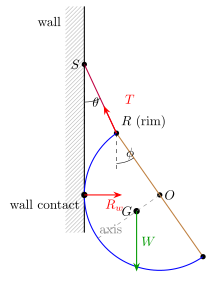
A solid hemisphere is supported by a string fixed to a point on its rim and to a point on a smooth vertical wall with which the curved surface is in contact. If θ is the angle of inclination of the string with vertical and ϕ is the angle of inclination of the plane base of the hemisphere to the vertical, then find the value of (tanϕ−tanθ).
Technique
2D cross-section through plane of symmetry; place wall-contact at origin and centre of hemisphere at (a,0); identify CG and rim attachment using the inclined axis; force balance + moments about wall-contact give the result.
Solution
Setup. Hemisphere of radius a, weight W. Curved surface touches a smooth vertical wall at one point. A string ties from a point on the rim to a point on the wall.
Place the wall along x=0. Let the contact point with the wall be the origin. The hemisphere’s centre O=(a,0) (since at the contact, the radius from the centre is horizontal, length a).
Base plane inclined at angle ϕ to vertical → axis of hemisphere (perpendicular to base) inclined at angle ϕ to horizontal. Choose the orientation: axis points from O toward the wall (the curved side), with the rim above the contact point.
In a 2D cross-section through the symmetry plane: axis direction = (−cosϕ,−sinϕ) (the centre of mass is between O and the wall, slightly below the horizontal line through O).
Centre of gravity of solid hemisphere is at distance 3a/8 from the centre of the flat base, along the axis (toward the curved side). So
G=O+83a(−cosϕ,−sinϕ)=(a−83acosϕ,−83asinϕ).
Rim attachment pointR: on the rim, in our 2D cross-section. The rim is a circle in the base plane (centred at O, radius a). In 2D cross-section, the rim has two points; pick the upper one (where string is naturally attached):
R=O+a⋅(rotate axis by 90° CCW)=O+a(−sinϕ,cosϕ)⋅(sign)=(a−asinϕ,acosϕ).
(The rotation: axis =(−cosϕ,−sinϕ); rotate 90° CCW: (sinϕ,−cosϕ) or CW (−sinϕ,cosϕ). Take the one with positive y-component → (−sinϕ,cosϕ).)
Step 1 — Force balance
Forces on hemisphere:
Weight W downward at G.
Wall reaction Rw horizontal at the wall-contact (0,0), pointing +x (perpendicular to smooth wall).
String tension T at R, along direction toward the wall point. The string makes angle θ with vertical, with the wall on the −x side, so direction =(−sinθ,cosθ) (toward wall and upward).
Vertical equilibrium:Tcosθ=W, so T=W/cosθ.
Horizontal equilibrium:Rw−Tsinθ=0, so Rw=Tsinθ=Wtanθ.
Step 2 — Take moments about wall-contact (0,0)
Wall reaction Rw acts at the moment axis: zero moment.
Weight W at G=(a(1−3cosϕ/8),−3asinϕ/8): moment z-component =xG⋅(−W)−yG⋅0=−Wa(1−3cosϕ/8)⋅1. Hmm we want the convention: moment of F=(0,−W) at position r=G: moment z=xG⋅Fy−yG⋅Fx=xG(−W)−yG⋅0=−WxG.
So MW=−W⋅a(1−3cosϕ/8)=−Wa(8−3cosϕ)/8. (Negative = clockwise.)
String tension T(−sinθ,cosθ) at R=(a(1−sinϕ),acosϕ): moment z-component =xR⋅Fy−yR⋅Fx=a(1−sinϕ)⋅Tcosθ−acosϕ⋅T(−sinθ)=aT[(1−sinϕ)cosθ+cosϕsinθ]. (Positive = counter-clockwise.)