← 2024 Paper 1

UPSC 2024 Maths Optional Paper 1 Q6a — Step-by-Step Solution

15 marks · Section B

Principle of virtual work · Dynamics & Statics · asked 6× in 13 yrs · Read the full method →

Question

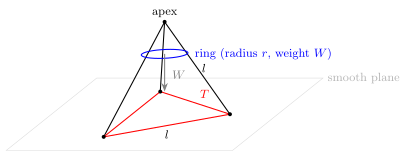
A regular tetrahedron, formed of six light rods each of length ll, rests on a smooth horizontal plane. A ring of weight WW and radius rr is supported by the slant sides. Using the principle of virtual work, find the stress in any of the horizontal sides.

Technique

Parametrise the configuration by base-edge length ss; compute the ring height z(s)z(s); differentiate; apply virtual work with three base-rod tensions and the ring’s weight.

Solution

Regular tetrahedron of six light rods (length l) on a smooth horizontal plane. The three base rods (red) are the horizontal sides whose stress T is sought; the three slant rods rise to the apex. A ring of radius r and weight W rests horizontally on the three slant rods. The virtual work is done as the base triangle's side s is varied, changing the apex height and hence the ring's height z(s).

Setup. The base is an equilateral triangle of side ss (varied); three slant rods of fixed length ll meet at the apex. The apex height is h(s)=l2s2/3h(s)=\sqrt{l^2-s^2/3}. The circumradius of the base triangle is s/3s/\sqrt{3}.

Step 1 — Height of the ring.

The ring of radius rr (centred on the axis) rests on the three slant rods. At depth dd below the apex the slant rods are at horizontal distance (s/3)(d/h)(s/\sqrt{3})(d/h) from the axis. Setting this equal to rr:

d=rh3s,z(s)=h(s) ⁣(1r3s).d=\frac{r h\sqrt{3}}{s},\qquad z(s)=h(s)\!\left(1-\frac{r\sqrt{3}}{s}\right).

Step 2 — Differentiate zz at s=ls=l.

h(l)=l63,dhdss=l=l/3l2/3=16.h(l)=\frac{l\sqrt{6}}{3},\qquad\frac{dh}{ds}\bigg|_{s=l}=\frac{-l/3}{l\sqrt{2/3}}=\frac{-1}{\sqrt{6}}.

By the product rule:

dzdss=l=16 ⁣(1r3l)+l63r3l2=16+rl2+r2l=16+3rl2.\frac{dz}{ds}\bigg|_{s=l}=-\frac{1}{\sqrt{6}}\!\left(1-\frac{r\sqrt{3}}{l}\right)+\frac{l\sqrt{6}}{3}\cdot\frac{r\sqrt{3}}{l^2}=-\frac{1}{\sqrt{6}}+\frac{r}{l\sqrt{2}}+\frac{r\sqrt{2}}{l}=-\frac{1}{\sqrt{6}}+\frac{3r}{l\sqrt{2}}.

Step 3 — Virtual work.

In a virtual displacement δs\delta s (each base edge lengthens by δs\delta s):

Setting total virtual work to zero:

3TδsWdzdsδs=0    T=W3dzdss=l.-3T\,\delta s-W\frac{dz}{ds}\,\delta s=0\;\Rightarrow\;T=-\frac{W}{3}\cdot\frac{dz}{ds}\bigg|_{s=l}. T=W3 ⁣(16+3r22l)=W36Wr22l=W6189Wr218l=W2(l39r)18l.T=-\frac{W}{3}\!\left(-\frac{1}{\sqrt{6}}+\frac{3r\sqrt{2}}{2l}\right)=\frac{W}{3\sqrt{6}}-\frac{Wr\sqrt{2}}{2l}=\frac{W\sqrt{6}}{18}-\frac{9Wr\sqrt{2}}{18l}=\frac{W\sqrt{2}(l\sqrt{3}-9r)}{18l}.

T>0T>0 (tension) when r<l3/9r<l\sqrt{3}/9; T<0T<0 (compression) otherwise.

Answer

  T=W2(l39r)18l.  \boxed{\;T=\frac{W\sqrt{2}(l\sqrt{3}-9r)}{18l}.\;}
We post more of this — worked solutions, CSAT trap breakdowns, guide chapters — a few times a week on Telegram. Free, no sign-in. Join

This solution is part of the Maths Coverage Map — 13 years, mapped. Get the take-away PDF free.