← 2024 Paper 1
UPSC 2024 Maths Optional Paper 1 Q7c — Step-by-Step Solution 20 marks · Section B
Stokes' theorem · Vector Analysis · asked 10× in 13 yrs · Read the full method →
Question
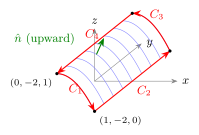
State Stokes’ theorem and verify it for F ⃗ = x y i ^ + y z j ^ + z x k ^ \vec F=xy\hat i+yz\hat j+zx\hat k F = x y i ^ + y z j ^ + z x k ^ S S S z = 1 − x 2 z=1-x^2 z = 1 − x 2 0 ≤ x ≤ 1 0\le x\le 1 0 ≤ x ≤ 1 − 2 ≤ y ≤ 2 -2\le y\le 2 − 2 ≤ y ≤ 2
Technique
Direct computation of both sides; use n ^ d S = ( − g x , − g y , 1 ) d x d y \hat n\,dS=(-g_x,-g_y,1)\,dx\,dy n ^ d S = ( − g x , − g y , 1 ) d x d y y y y
Solution
Stokes’ Theorem
Let S S S C = ∂ S C=\partial S C = ∂ S F ⃗ \vec F F C 1 C^1 C 1
∮ C F ⃗ ⋅ d r ⃗ = ∬ S ( ∇ × F ⃗ ) ⋅ n ^ d S . \oint_{C}\vec F\cdot d\vec r=\iint_S(\nabla\times\vec F)\cdot\hat n\,dS. ∮ C F ⋅ d r = ∬ S ( ∇ × F ) ⋅ n ^ d S . Setup
S S S ( x , y ) (x,y) ( x , y ) D = [ 0 , 1 ] × [ − 2 , 2 ] D=[0,1]\times[-2,2] D = [ 0 , 1 ] × [ − 2 , 2 ] z = g ( x , y ) = 1 − x 2 z=g(x,y)=1-x^2 z = g ( x , y ) = 1 − x 2 n ^ d S = ( − g x , − g y , 1 ) d x d y = ( 2 x , 0 , 1 ) d x d y \hat n\,dS=(-g_x,-g_y,1)\,dx\,dy=(2x,0,1)\,dx\,dy n ^ d S = ( − g x , − g y , 1 ) d x d y = ( 2 x , 0 , 1 ) d x d y
The boundary C C C
Piece Parametrisation Range C 1 C_1 C 1 r ⃗ = ( x , − 2 , 1 − x 2 ) \vec r=(x,-2,1-x^2) r = ( x , − 2 , 1 − x 2 ) x : 0 → 1 x:0\to 1 x : 0 → 1 C 2 C_2 C 2 r ⃗ = ( 1 , y , 0 ) \vec r=(1,y,0) r = ( 1 , y , 0 ) y : − 2 → 2 y:-2\to 2 y : − 2 → 2 C 3 C_3 C 3 r ⃗ = ( x , 2 , 1 − x 2 ) \vec r=(x,2,1-x^2) r = ( x , 2 , 1 − x 2 ) x : 1 → 0 x:1\to 0 x : 1 → 0 C 4 C_4 C 4 r ⃗ = ( 0 , y , 1 ) \vec r=(0,y,1) r = ( 0 , y , 1 ) y : 2 → − 2 y:2\to -2 y : 2 → − 2
LHS — ∮ C F ⃗ ⋅ d r ⃗ \oint_C\vec F\cdot d\vec r ∮ C F ⋅ d r
C 1 C_1 C 1 d r ⃗ = ( 1 , 0 , − 2 x ) d x d\vec r=(1,0,-2x)\,dx d r = ( 1 , 0 , − 2 x ) d x F ⃗ = ( − 2 x , − 2 ( 1 − x 2 ) , x ( 1 − x 2 ) ) \vec F=(-2x,-2(1-x^2),x(1-x^2)) F = ( − 2 x , − 2 ( 1 − x 2 ) , x ( 1 − x 2 ))
∫ 0 1 ( − 2 x − 2 x 2 ( 1 − x 2 ) ( − 2 x ) ) ⋯ = ∫ 0 1 ( − 2 x − 2 x 2 + 2 x 4 ) d x = − 1 − 2 3 + 2 5 = − 19 15 . \int_0^1(-2x-2x^2(1-x^2)(-2x))\cdots\;=\;\int_0^1(-2x-2x^2+2x^4)\,dx=-1-\tfrac{2}{3}+\tfrac{2}{5}=-\tfrac{19}{15}. ∫ 0 1 ( − 2 x − 2 x 2 ( 1 − x 2 ) ( − 2 x )) ⋯ = ∫ 0 1 ( − 2 x − 2 x 2 + 2 x 4 ) d x = − 1 − 3 2 + 5 2 = − 15 19 . Actually computing F ⃗ ⋅ d r ⃗ = ( − 2 x ) ( 1 ) + ( 0 ) + x ( 1 − x 2 ) ( − 2 x ) = − 2 x − 2 x 2 + 2 x 4 \vec F\cdot d\vec r=(-2x)(1)+(0)+x(1-x^2)(-2x)=-2x-2x^2+2x^4 F ⋅ d r = ( − 2 x ) ( 1 ) + ( 0 ) + x ( 1 − x 2 ) ( − 2 x ) = − 2 x − 2 x 2 + 2 x 4
∫ 0 1 ( − 2 x − 2 x 2 + 2 x 4 ) d x = [ − x 2 − 2 x 3 3 + 2 x 5 5 ] 0 1 = − 1 − 2 3 + 2 5 = − 19 15 . \int_0^1(-2x-2x^2+2x^4)\,dx=[-x^2-\tfrac{2x^3}{3}+\tfrac{2x^5}{5}]_0^1=-1-\tfrac{2}{3}+\tfrac{2}{5}=-\tfrac{19}{15}. ∫ 0 1 ( − 2 x − 2 x 2 + 2 x 4 ) d x = [ − x 2 − 3 2 x 3 + 5 2 x 5 ] 0 1 = − 1 − 3 2 + 5 2 = − 15 19 . C 2 C_2 C 2 d r ⃗ = ( 0 , 1 , 0 ) d y d\vec r=(0,1,0)\,dy d r = ( 0 , 1 , 0 ) d y F ⃗ ⋅ d r ⃗ = y ⋅ 0 = 0 \vec F\cdot d\vec r=y\cdot 0=0 F ⋅ d r = y ⋅ 0 = 0 = 0 =0 = 0
C 3 C_3 C 3 d r ⃗ = ( 1 , 0 , − 2 x ) d x d\vec r=(1,0,-2x)\,dx d r = ( 1 , 0 , − 2 x ) d x x : 1 → 0 x:1\to 0 x : 1 → 0 F ⃗ = ( 2 x , 2 ( 1 − x 2 ) , x ( 1 − x 2 ) ) \vec F=(2x,2(1-x^2),x(1-x^2)) F = ( 2 x , 2 ( 1 − x 2 ) , x ( 1 − x 2 )) F ⃗ ⋅ d r ⃗ = 2 x + x ( 1 − x 2 ) ( − 2 x ) = 2 x − 2 x 2 + 2 x 4 \vec F\cdot d\vec r=2x+x(1-x^2)(-2x)=2x-2x^2+2x^4 F ⋅ d r = 2 x + x ( 1 − x 2 ) ( − 2 x ) = 2 x − 2 x 2 + 2 x 4
∫ 1 0 ( 2 x − 2 x 2 + 2 x 4 ) d x = − ∫ 0 1 ( 2 x − 2 x 2 + 2 x 4 ) d x = − ( 1 − 2 3 + 2 5 ) = − 11 15 . \int_1^0(2x-2x^2+2x^4)\,dx=-\int_0^1(2x-2x^2+2x^4)\,dx=-(1-\tfrac{2}{3}+\tfrac{2}{5})=-\tfrac{11}{15}. ∫ 1 0 ( 2 x − 2 x 2 + 2 x 4 ) d x = − ∫ 0 1 ( 2 x − 2 x 2 + 2 x 4 ) d x = − ( 1 − 3 2 + 5 2 ) = − 15 11 . C 4 C_4 C 4 d r ⃗ = ( 0 , 1 , 0 ) d y d\vec r=(0,1,0)\,dy d r = ( 0 , 1 , 0 ) d y y : 2 → − 2 y:2\to -2 y : 2 → − 2 F ⃗ ⋅ d r ⃗ = y \vec F\cdot d\vec r=y F ⋅ d r = y ∫ 2 − 2 y d y = 0 \int_2^{-2}y\,dy=0 ∫ 2 − 2 y d y = 0
Total: − 19 15 + 0 − 11 15 + 0 = − 2 -\tfrac{19}{15}+0-\tfrac{11}{15}+0=-2 − 15 19 + 0 − 15 11 + 0 = − 2
RHS — ∬ S ( ∇ × F ⃗ ) ⋅ n ^ d S \iint_S(\nabla\times\vec F)\cdot\hat n\,dS ∬ S ( ∇ × F ) ⋅ n ^ d S
∇ × F ⃗ = ( − y , − z , − x ) . \nabla\times\vec F=(-y,-z,-x). ∇ × F = ( − y , − z , − x ) . ( ∇ × F ⃗ ) ⋅ n ^ d S = ( − y ) ( 2 x ) + ( − z ) ( 0 ) + ( − x ) ( 1 ) d x d y = ( − 2 x y − x ) d x d y . (\nabla\times\vec F)\cdot\hat n\,dS=(-y)(2x)+(-z)(0)+(-x)(1)\,dx\,dy=(-2xy-x)\,dx\,dy. ( ∇ × F ) ⋅ n ^ d S = ( − y ) ( 2 x ) + ( − z ) ( 0 ) + ( − x ) ( 1 ) d x d y = ( − 2 x y − x ) d x d y . ∫ 0 1 ∫ − 2 2 ( − 2 x y − x ) d y d x . \int_0^1\!\!\int_{-2}^{2}(-2xy-x)\,dy\,dx. ∫ 0 1 ∫ − 2 2 ( − 2 x y − x ) d y d x . Inner: ∫ − 2 2 − 2 x y d y = 0 \int_{-2}^{2}-2xy\,dy=0 ∫ − 2 2 − 2 x y d y = 0 y y y ∫ − 2 2 − x d y = − 4 x \int_{-2}^{2}-x\,dy=-4x ∫ − 2 2 − x d y = − 4 x = − 4 x =-4x = − 4 x
∫ 0 1 − 4 x d x = − 2. \int_0^1-4x\,dx=-2. ∫ 0 1 − 4 x d x = − 2. Both sides equal − 2 -2 − 2
Answer
∮ C F ⃗ ⋅ d r ⃗ = ∬ S ( ∇ × F ⃗ ) ⋅ n ^ d S = − 2. \boxed{\;\oint_C\vec F\cdot d\vec r=\iint_S(\nabla\times\vec F)\cdot\hat n\,dS=-2.\;} ∮ C F ⋅ d r = ∬ S ( ∇ × F ) ⋅ n ^ d S = − 2.